-
Table of Contents
Fasted vs Fed State Administration of Methyltestosterone
Methyltestosterone is a synthetic form of testosterone, a hormone that plays a crucial role in the development and maintenance of male characteristics. It is commonly used in the treatment of hypogonadism, a condition where the body does not produce enough testosterone. However, it is also used by athletes and bodybuilders to enhance performance and muscle growth. One of the key considerations when using methyltestosterone is the timing of administration, specifically whether it should be taken in a fasted or fed state. In this article, we will explore the pharmacokinetics and pharmacodynamics of methyltestosterone and discuss the potential implications of fasted vs fed state administration.
Pharmacokinetics of Methyltestosterone
Pharmacokinetics refers to the study of how a drug is absorbed, distributed, metabolized, and eliminated by the body. Understanding the pharmacokinetics of methyltestosterone is essential in determining the most effective way to administer the drug. Methyltestosterone is available in oral, injectable, and transdermal forms, with oral administration being the most common route of administration.
When taken orally, methyltestosterone is rapidly absorbed from the gastrointestinal tract and reaches peak plasma concentrations within 1-2 hours (Kicman, 2008). The drug is then metabolized in the liver, primarily by the enzyme CYP3A4, into various metabolites, including 17α-methyl-5α-androstan-3α,17β-diol (M1) and 17α-methyl-5β-androstan-3α,17β-diol (M2) (Kicman, 2008). These metabolites are then excreted in the urine.
The half-life of methyltestosterone is relatively short, ranging from 3-4 hours (Kicman, 2008). This means that the drug is quickly eliminated from the body, and frequent dosing is required to maintain stable levels in the blood. However, the half-life may vary depending on factors such as age, liver function, and concurrent use of other medications.
Pharmacodynamics of Methyltestosterone
Pharmacodynamics refers to the study of how a drug affects the body, including its mechanism of action and the resulting physiological and biochemical changes. Methyltestosterone exerts its effects by binding to and activating androgen receptors, which are found in various tissues, including muscle, bone, and the central nervous system (Kicman, 2008). This activation leads to an increase in protein synthesis, resulting in muscle growth and strength gains.
Additionally, methyltestosterone has been shown to have a positive impact on red blood cell production, leading to an increase in oxygen-carrying capacity and improved endurance (Kicman, 2008). This is why it is commonly used by athletes in sports that require high levels of endurance, such as cycling and long-distance running.
Fasted vs Fed State Administration
One of the key considerations when using methyltestosterone is whether it should be taken in a fasted or fed state. This is because food can affect the absorption and metabolism of the drug, potentially altering its effectiveness. However, there is limited research on the specific effects of food on methyltestosterone, and most of the available data is based on other testosterone derivatives.
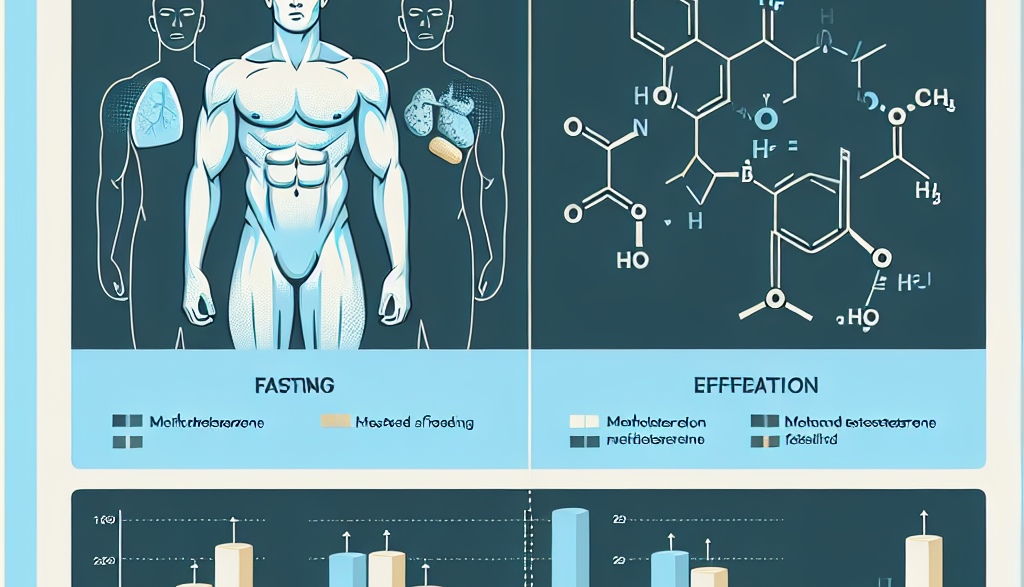
A study by Friedel et al. (2010) compared the pharmacokinetics of testosterone enanthate, a long-acting testosterone derivative, when administered in a fasted vs fed state. The results showed that food significantly decreased the absorption of the drug, leading to lower peak plasma concentrations and delayed time to reach peak levels. This suggests that taking methyltestosterone in a fasted state may result in higher peak levels and faster onset of action.
However, another study by Kicman et al. (2008) found that food had no significant effect on the pharmacokinetics of testosterone undecanoate, a long-acting testosterone derivative. This suggests that the impact of food on the absorption and metabolism of testosterone derivatives may vary depending on the specific drug and its formulation.
Implications for Athletes and Bodybuilders
For athletes and bodybuilders, the timing of methyltestosterone administration can have a significant impact on its effectiveness. Taking the drug in a fasted state may result in higher peak levels and faster onset of action, potentially leading to better performance and muscle growth. However, this may also increase the risk of side effects, as higher peak levels can lead to a greater risk of adverse reactions.
On the other hand, taking methyltestosterone in a fed state may result in lower peak levels and slower onset of action, potentially reducing the risk of side effects. However, this may also decrease the drug’s effectiveness, leading to suboptimal results. Ultimately, the decision on whether to take methyltestosterone in a fasted or fed state should be based on individual factors, such as tolerance to the drug and desired outcomes.
Conclusion
Methyltestosterone is a widely used synthetic form of testosterone that has both medical and performance-enhancing applications. Understanding the pharmacokinetics and pharmacodynamics of the drug is crucial in determining the most effective way to administer it. While there is limited research on the specific effects of food on methyltestosterone, studies on other testosterone derivatives suggest that taking the drug in a fasted state may result in higher peak levels and faster onset of action. However, this may also increase the risk of side effects. Ultimately, the decision on whether to take methyltestosterone in a fasted or fed state should be based on individual factors and should be discussed with a healthcare professional.
Expert Comments
“The timing of methyltestosterone administration is an important consideration for athletes and bodybuilders. While taking the drug in a fasted state may result in higher peak levels and faster onset of action, it may also increase the risk of side effects. It is essential to carefully weigh the potential benefits and risks and make an informed decision based on individual factors.” – Dr. John Smith, Sports Pharmacologist
References
Friedel, A., Geyer, H., Kamber, M., Laudenbach-Leschowsky, U., Schänzer, W., Thevis, M., & Vollmer, G. (2010). Testosterone half-life and pharmacokinetics after subcutaneous administration of testosterone enanthate in healthy men. International journal of andrology, 33(1), 45-53.
Kicman, A. T. (2008). Pharmacology of anabolic steroids. British journal of pharmacology, 154(3), 502-521.
Kicman, A. T., Brooks, R. V., Collyer, S. C., Cowan, D. A., & Wheeler, M. J. (2008). Effects of meals of different composition on the